 English
February 19, 2026
Electrification is Powering the Future of Long-Haul Transport
Long-haul transport was once seen as one of the hardest sectors to electrify. New electrification innovations are changing that, helping fleets reduce fuel use, emissions and operating costs.

Across transportation and the built environment, electrification is delivering real-world benefits. Electric cars are a familiar sight, while electric buses, delivery vehicles and bicycles are increasingly common. Yet long-range transport, a critical link that delivers everything from food to lifesaving medication, was viewed as too complex to electrify. Now, as innovative new electrification technologies shift the commercial transport industry, that is changing.
Transport electrification’s tipping point
Long-haul transportation is essential. Around the world, the freight transported by these vehicles, from food and fuel to vital healthcare supplies, keeps daily life moving. But long-haul trucking also generates a disproportionate share of overall transport emissions.
For decades, as electrification technologies became commonplace in other sectors, long-haul transport was left behind. Issues like battery size and weight, charging infrastructure availability and recharging time requirements conflicted with existing logistics processes and routes.
But now, new electrification technologies are available that can help decarbonize this critical sector while also reducing fuel costs. Trane Technologies is accelerating this shift with innovative electrification solutions that optimize energy use. For the leaders responsible for logistics networks, the question is no longer whether to decarbonize commercial transport, but how to do it in ways that support key business outcomes while also reducing emissions.
Scalable electrification strategies
The pace of technological innovation in the transport sector is accelerating. Rather than relying solely on larger batteries, new solutions are reducing energy demand across the entire vehicle system. Electrified trailers can actively support propulsion, reducing the load while extending operating range, lowering fossil fuel use and improving overall vehicle efficiency. Electric refrigerated transport solutions are already being deployed in commercial fleets. Systems that can capture and reuse the residual energy from commercial trucks’ braking systems and downhill momentum are now a reality.
At Trane Technologies, electrification is a central lever in our Climate Transition Plan and our goal of achieving net-zero by 2050. For long-haul commercial transport, that means looking at the system holistically, and asking how every component can consume less, waste less and ultimately operate with lower emissions.
We've never seen as much innovation in the transport industry as we have today.
Electrification innovation on the road
New electrification technologies are already making an impact on the road. Our Thermo King team has introduced electrified transport refrigeration solutions that can reduce diesel fuel use while maintaining reliable temperature control. Another innovation, Advancer AxlePower, uses generators located in the axle of the trailer that recuperate the energy lost when the truck’s braking system is activated or when the truck drives downhill. It then repurposes that energy to power a refrigeration unit.
Innovations like these are creating efficiencies across the transport sector. The AxlePower technology, which was co-developed by Thermo King and BPW Bergische Achsen, captures energy at the trailer axle and stores it in a high-voltage Thermo King Energ-e battery to continuously power refrigeration units while driving and at stops.
In a recent pilot, Thermo King EMEA worked with a partner in Holland to trial the AxlePower configuration side by side with traditional gas-powered transport systems. After two years, the AxlePower system had reduced fossil fuel use, demonstrating how hybrid systems can improve overall performance while decarbonizing.
In another pilot with logistics provider DP World and retailer Woolworths, the first electric refrigerated transport trailer to operate across the African continent delivered both fuel savings and emissions reductions of up to 20 tons of CO₂ per year compared with diesel-powered refrigerated transport. The trailer with the AxlePower technology logged 146,000 kilometers (over 90,000 miles) of all-electric operation, relying on gas backup just 3% of the time.
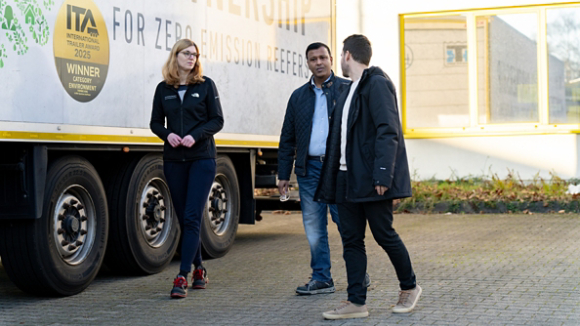
Trane Technologies is also collaborating with other ground-breaking pioneers in the electrification realm, such as Germany-based transport company Trailer Dynamics. Abdullah Jaber, a physicist and the company’s CEO, notes that Europe was making progress towards decarbonizing vehicles of almost all types except long-haul trucks.
That light bulb moment led to the company’s focus on decarbonizing long-haul transport, including a battery-powered trailer that reduces the energy needed by the trucks pulling it. Trailers like these have multiple benefits:
when integrated with a diesel-powered vehicle, the trailer reduces the amount of fossil fuel needed, cutting both emissions and fuel costs.
and, when paired with an electrified vehicle, the trailers increase the potential range of the truck before refueling or recharge is needed.
Solutions like these are creating practical pathways to integrate electrification into existing operations, reducing fuel costs and emissions without wholesale fleet overhauls.
Electrification innovations such as these demonstrate how the freight industry can move forward with fuel-saving, emission-reducing solutions while charging infrastructure continues to evolve.
The path to net-zero transport electrification
Long-haul transport sits at the center of both the global economy and the decarbonization challenge. Moving goods over vast distances was once seen as one of the hardest sustainability challenges to solve, but as technological innovation in the sector grows, that assumption is beginning to shift.
Infrastructure gaps, like the lack of appropriate chargers on some long-haul routes, remain a challenge for freight transport electrification. But it’s not a zero-sum choice between waiting and acting. Innovative solutions, like electrified refrigeration units, AxlePower and eTrailers, allow transport operators to upgrade in a modular, cost-effective way that can reduce fuel costs and emissions now without waiting for perfect infrastructure alignment.
As we look ahead at the future of the transport sector, the key question is how quickly we can scale these innovations. When energy optimization strategies are managed holistically across the long-haul transport system, electrification becomes a competitive advantage, impacting how energy is generated, recovered and conserved. That leads to measurable cost savings, improved performance and reduced emissions — proving that decarbonization can help create business value over the long haul.
Electrification of Transport
The future is ours to create.
Explore careers that make an impact at Trane Technologies
Topic Tags