
 English
February 26, 2026
Thermal Management Systems for a Sustainable Future
Thermal management systems transform how buildings use heat by recovering and reusing energy that would otherwise be wasted. Learn how Trane Technologies customers like Organon are cutting fuel costs, lowering emissions and building resilience.


Across industries around the world, business leaders understand that the energy consumed by the built environment has significant climate impacts, contributing up to 30% of global emissions. But for the people responsible for keeping a hospital running, a factory productive or a campus comfortable, the energy transition can feel complex and hard to prioritize.
I’ve spent three decades in this industry, from my early days as a young engineer in Australia and La Crosse, Wisconsin, to my current role as Trane Technologies group president across Europe, the Middle East and Africa. In that time, I’ve lived in all kinds of climates and experienced the full temperature spectrum, from +40°C summer days in Sydney to –30°C winters in Wisconsin. Through those extremes, one thing remains constant: heating and cooling keep our infrastructure running, from our daily living environments to manufacturing and the cold chain.
The real question is how we choose to meet these heating and cooling needs, in a way that is reliable, cost effective and low carbon. One of the most powerful tools we have for decarbonizing buildings while saving on energy costs is a technology that may still feel new to some people: thermal management systems.
What is a thermal management system?
Traditionally, the industry has treated heating and cooling as two separate silos. One system is for cooling, and another for heating, with excess heat vented out into the atmosphere. The result is wasted energy: one part of the system is throwing heat away while another burns fossil fuels to create new heating. From both cost and emissions perspectives, that’s a huge missed opportunity.
Thermal management systems can help solve this issue. They provide an integrated approach that manages both heating and cooling needs holistically across a building or a site, rather than as separate silos. These systems capture heat that would normally be wasted, and reuse it for comfort heating, hot water or other needs instead of burning new fossil fuels. By recovering and reusing this energy, thermal management systems can deliver much higher efficiency and lower emissions than traditional setups.
What do thermal management systems look like in practice? Depending on the building or site’s needs, a thermal management system might use heat pumps, high-efficiency chillers, heat recovery units, thermal energy storage or a combination of these tools for maximum efficiency. With the addition of cutting-edge technologies like intelligent digital building controls and AI-powered energy optimization, we can coordinate these systems together to heat and cool in the most efficient (and cost-effective) way possible.
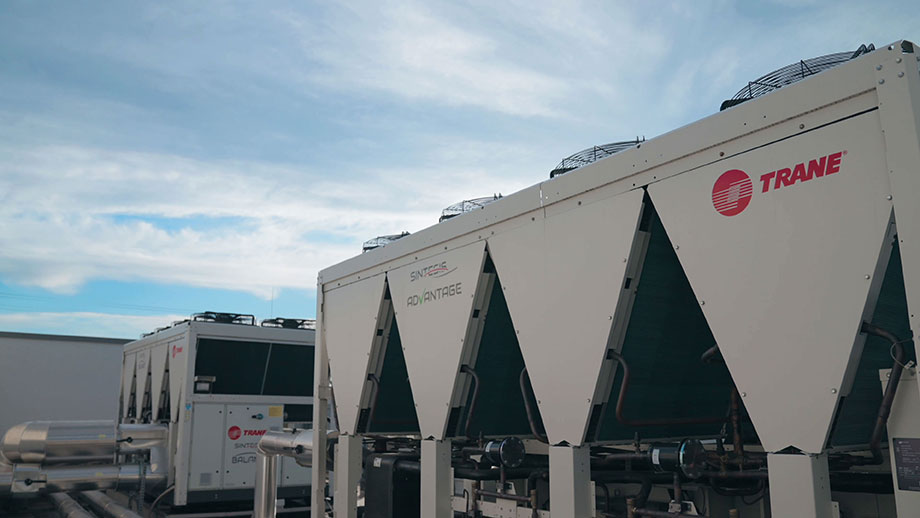
A thermal management system is an equipment like we have here behind me, or a combination of equipment that use thermodynamic cycle and only electricity for satisfying the cooling and heating requirement in a building or in a process. If you look at traditional design for heating and cooling system in a building, it's based on two separate systems. On one side, you have the heating system, and the heating system is based on a boiler. So you burn fuel, gas for producing the heat. On the other side, you have the cooling system. It's based on chiller. And these chillers are completely disconnected from the heating system. With a thermal management system like you have here, you are connected to both sides of the heating and the cooling side. That means we can benefit from the recovery from the cooling side for satisfying partially or totally the building requirement in terms of heating or domestic hot water production. Most of the buildings, they require heating and cooling. Simultaneous need depends really on the type of building. But you have building where you have a lot of potential for recovering the energy. For example, the hospital. In a hospital, you need cooling, whatever the period of the year. And during the winter time, you need heating. The same in the summer. Even if you don't heat the building itself, you need to produce sanitary hot water for the hospital. So there is a huge potential for recovering the heat from the cooling system for satisfying partially or some time to time totally the heating requirement of a building. So let's take the example in the industry. This unit can operate in heating mode, cooling mode or heat recovery mode and can combine the different modes. In fact, there is 3 heat exchangers on this unit. One of the heat exchangers is connected to the cooling side, the other one is connected to the heating side, and we have an air heat exchanger. This air heat exchanger is used for balance the difference between the heating demand and the cooling demand in the boiling. With the air heat exchanger, we can satisfy, I would say, what is missing in the building? Meaning we can reject when we have too much cooling demand in the building. We can reject the excess heat. When there is not enough heating in the building that can be recovered from the cooling side, we can extract it from the air. Business benefits is mainly in terms of efficiency. With this type of system, you can reach 300%-400% efficiency. So that means you can improve the efficiency and reduce the operating costs. On the top of that, you are reducing your carbon emission. Something that will improve the efficiency of the thermal management system is combining the thermal management system with storage in the building, heating or cooling storage. because you can store and harvest the energy when the building doesn't really need it and use it for later. An additional one, and I think it will be really the future, is AI. Combining AI, meaning getting data from the building regarding the building occupancy, the building behavior with the thermal management system and the storage will tremendously improve the efficiency in the building.
The ROI of thermal management
Often, building owners, managers or even design engineers just aren’t aware that their facilities are heating and cooling at the same time while using separate systems. They don’t see the hidden flows of energy or the heat being ejected on one side of the building while another system works hard to generate new heat. This “leakage” of energy that’s already been paid for is an avoidable cost, funding waste instead of efficient performance.
But when people learn that a thermal management system can significantly reduce both emissions and operating costs, sometimes the next assumption they make is that it will be too expensive or too difficult to implement. In reality, thermal management systems that manage heating and cooling can be up to 400% more efficient than traditional systems, creating both cost savings and decarbonization.
Often, the cost of moving to a thermal management system can achieve full payback of the incremental system cost in just a few years through avoided energy costs and improved efficiency, even before factoring in emissions reductions and sustainability goals. There is no tradeoff, investments like these can have multi-faceted returns, reducing emissions and saving money at the same time.
Starting small: lessons from Organon
One of my favorite examples comes from Organon, a global pharmaceutical company focused on women’s health. Their largest manufacturing site in Oss in the Netherlands has a complex mix of processes, utilities and office space. It’s exactly the kind of environment where a thermal management system can make a big difference.
Innovating for Impact: Thermal Management Improves HVAC System Sustainability for Global Healthcare Company

Their sustainability lead, Stan Van Hastenberg, did not start with a mega-project. He started with good, old-fashioned detective work. First, the team looked at basic energy-saving measures. Then, they broadened the lens to the longer-term energy transition and the role of their thermal energy system.
One major opportunity they found was in their compressed air system. The compressors needed to be cooled, and that cooling was generating a lot of excess heat that had historically been blown into the air. By introducing two heat pumps, they were able to cool the compressed air more efficiently and feed the captured heat back into their central heating system. The result was a reduced reliance on gas-fired boilers, lower energy use and a big step toward their goal of climate neutrality by 2035, all by rethinking how they managed and reused heat.
The Organon team is now applying similar thinking in their office buildings, pairing heat pumps with an aquifer thermal energy storage system in the soil to provide heating in winter and cooling in summer. Those steps have created momentum for bigger projects.
Harnessing heat for a sustainable future
Buildings — the spaces where we live, work, learn and play — will remain central to our lives and are one of the biggest opportunities for decarbonization. The most important step is to begin: start a project, learn from it, then scale.
The technology we need for efficient thermal management systems is available today, and the business case is strong. When a system can be up to four times more efficient than traditional setups, creating both cost savings and decarbonization, there are few reasons not to make the change.
The challenge, and the opportunity, is to rethink how we treat heat: not as waste to be thrown away, but as a valuable resource that we can recapture, redistribute and reuse. When we implement the technology to do that, we cut energy costs, reduce emissions and build more resilient operations on the path to a net-zero future.
Listen to this Healthy Spaces podcast episode to learn more about how to harness heat with thermal management systems.
Harnessing Heat – Thermal Management Systems
The future is ours to create.
Explore careers that make an impact at Trane Technologies
Topic Tags