 English
A Message from Mauro Atalla, our Chief Technology and Sustainability Officer
The world is at a pivotal moment, with data and energy shaping the future of the global economy. At Trane Technologies, we see this not just as a challenge, but as our greatest opportunity to lead and innovate for a more sustainable world. We’re transforming climate and energy management in buildings, industry, data centers and transport, and we are embedding AI into the core of our operations and products. This is creating smarter, more efficient systems that deliver tangible sustainability benefits for our customers and communities.
Scaling sustainability is the theme of our 2025 Sustainability Report. Scale takes many forms, from steady, incremental improvements that build over time, to breakthrough innovations that shift entire industries. Our success depends on both: daily actions that reflect our values and bold ideas that accelerate change and our purpose.
Read Mauro’s full message.

Our 2030 Sustainability Commitments
Our 2030 Sustainability Commitments provide a clear roadmap for advancing a more sustainable future and delivering results that extend across our value chain. They also inspire our people and guide how we engage partners to build new opportunities.
We are:
- Committed to our Gigaton Challenge to significantly reduce our customers’ carbon emissions and drive innovation.
- Leading by Example by reimagining our supply chain and operations to have a restorative impact on the environment.
- Creating Opportunity for All by uplifting our culture and communities through an inclusive approach with a focus on broadening access to education and rewarding career pathways.
Learn more about our 2030 Sustainability Commitments.
See how we calculate emissions reduction in our Gigaton Challenge playbook.
2030 Sustainability Commitment Highlights
331M
mtCO2e reduced from our customers’ carbon footprint since 2019 as part of Gigaton Challenge
84%
of electricity consumption came from renewable sources in 2025
80%
of the way to our cumulative 2030 goal to volunteer 500,000 hours
Our climate strategy
Our climate strategy and climate innovation are key aspects of our overall business and sustainability strategies. Based on the results of our materiality assessment, some of the highest priority material topics for our business include climate change, GHG emissions, energy, and energy-efficient and low-emission products.
We designed our 2030 Sustainability Commitments, 2050 Net-Zero Roadmap and supporting decarbonization levers to reduce emissions associated with our operations, our customers’ use of our products and our products’ life cycles.
Our Climate Transition Plan outlines our forward-looking climate strategy and addresses how we are:
- Planning to manage physical and transition climate risks and opportunities;
- Reducing carbon emissions in alignment with international climate agreements and
- Preparing for future policy, market and technological changes.
Explore our Climate Transition Plan.
Our science-based targets
Trane Technologies was the first in our industry — and one of the first companies in the world — to set a long-term net-zero 2050 target approved by the Science Based Targets initiative (SBTi). SBTi also approved our short-term emissions reduction targets, including our goals to:
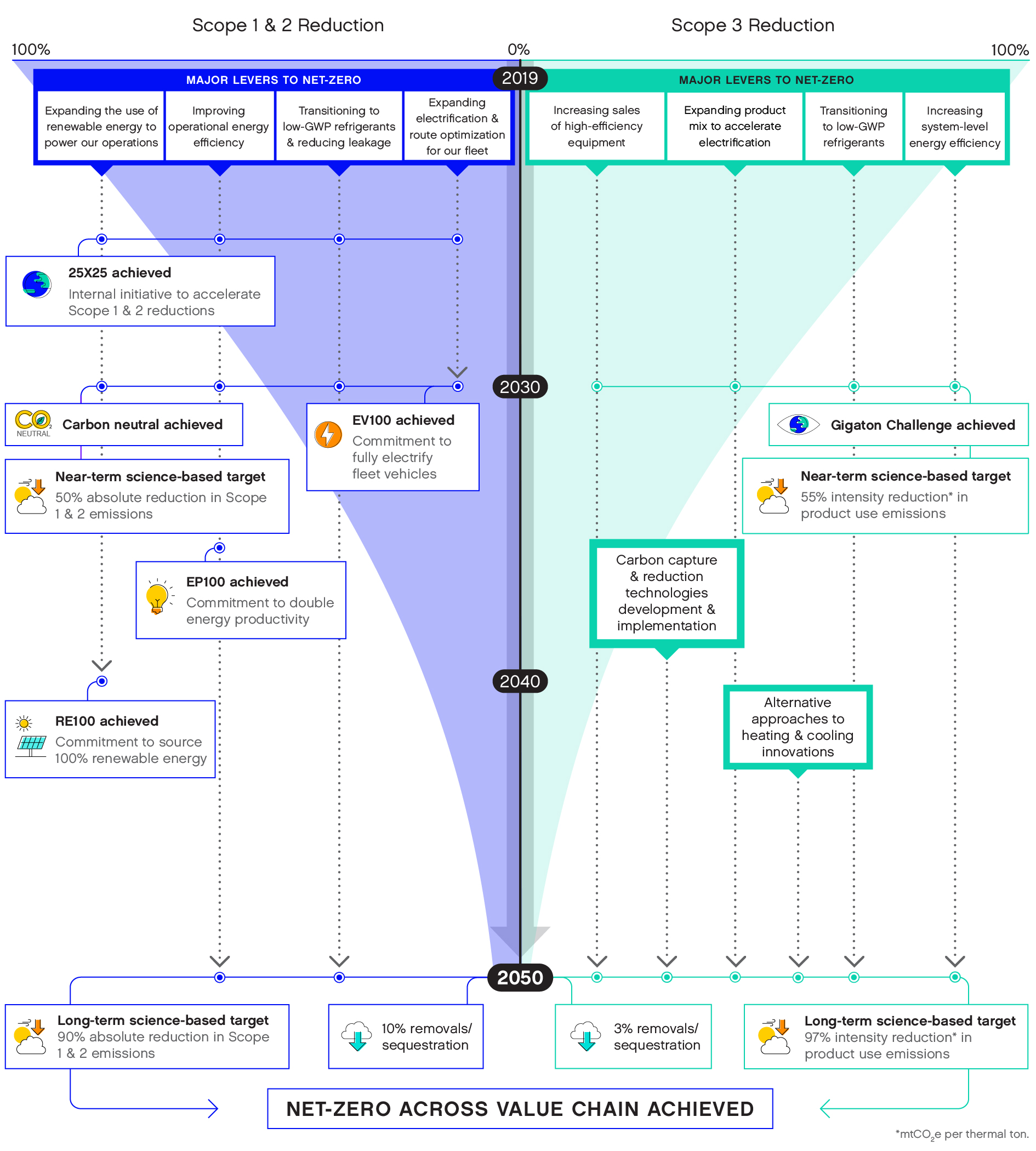
- Reduce our Scope 1 and 2 emissions by 50% below 2019 levels by 2030;
- Reduce Scope 3 emissions by 55% per tonnage (capacity) below 2019 levels by 2030; and
- Reach net-zero GHG emissions across our value chain by 2050 from a 2019 baseline.
These targets are aligned with international climate agreements’ aim to limit global temperature rise to 1.5 degrees Celsius.
Our 2050 Net-Zero Roadmap represents our plan to achieve net-zero emissions across our value chain. It is focused on our Scope 1, Scope 2 and Scope 3 Category 11 “use of sold products” science-based targets. The roadmap also includes internal and external commitments that contribute to reductions in emissions and can help us achieve our science-based targets.
Read more about the progress we’ve made in our 2025 Sustainability Report.