
 English
May 06, 2026
Regenerative Refrigerant: from Consumable to Circular Resource
In Thermo King’s laboratory in Barcelona, a single question sparked a new approach to refrigerant testing. By regenerating refrigerant instead of destroying it after each test, Santiago Martinez and his team created a circular process that reduces waste, lowers costs and cuts emissions while maintaining the precision required for certification testing.
If something still works, I don’t throw it away and buy something new. So, when I joined the Thermo King laboratory in Barcelona and saw that we were buying new refrigerant, running tests and then sending the used refrigerant to be destroyed, it didn’t sit right. It wasn’t sustainable, environmentally or financially.
We were paying twice — once for the new refrigerant and again to destroy the old one. Each time I signed off on another order, I thought: We’re throwing away something that still has value.
I knew something had to change.
The hidden waste problem in refrigerant testing
In engineering, we’re taught that system performance depends on the purity of the working fluid. As refrigerant circulates through a system, it picks up contaminants — mainly oil from the compressor and moisture from small leaks. Oil, in particular, degrades performance. It doesn’t transfer heat the way refrigerant does, so a contaminated charge won’t deliver the precision needed for certification testing.
That’s why the standard practice has always been to use new refrigerant. Clean input, reliable output. However, I’d seen a different approach work before. In an earlier role at Thermo King, I worked on marine refrigeration systems, where we routinely recovered and reused refrigerant. Marine compressors have very low oil circulation rates, so what you recover is almost clean. Road transport systems are different. Those compressors push much more oil into the system, so the recovered refrigerant is genuinely contaminated. That’s why we defaulted to buying new. Once I understood that, the next question was simple: what would it take to clean it properly?
Finding the solution in existing technology
I started talking to colleagues and suppliers and found that the technology already existed. Industrial processes can clean refrigerant and restore its chemical composition if it has shifted during recovery. That matters because refrigerant blends can separate. The most volatile components are recovered first, so unless you achieve a full recovery, the composition changes. Regeneration corrects for that.
We thought: If we could clean and rebalance the refrigerant, we could use it as if it were new.
There was some initial skepticism, but my team was open to trying something new, especially as it contributed to more sustainable practices. Together, we partnered with specialists who could remove contaminants, verify the composition and return the refrigerant for reuse. And so, our new system was born.
How the regenerative process works
Our process is straightforward, but technically rigorous at each step.
Before adopting this system as standard practice, we ran extensive side-by-side comparisons — new refrigerant against regenerated refrigerant, across multiple units and conditions. We only moved forward once the technicians working with these systems every day confirmed it performed to the same standard as new.
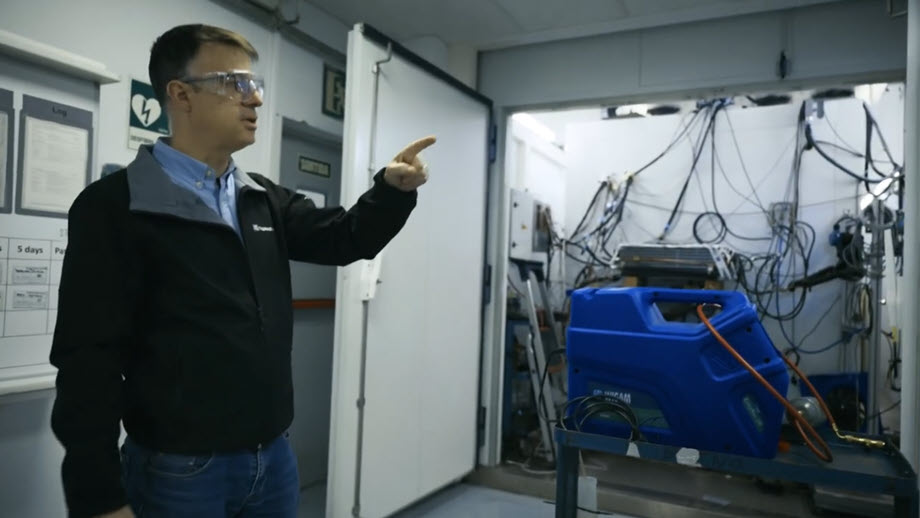
Watch the video
Side-by-side analysis confirming that regenerated refrigerant meets AHRI 700-2019 standards for R452A, including strict limits on contaminants and chemical composition.
I'm Santiago Martinez. I'm the laboratory manager here in Barcelona and also the refrigeration core lead. When I joined in the position of managing the labs in Barcelona, I was surprised. I was asking why we need to use new refrigerant for every test. To me, it was crazy because when we recover this refrigerant and we use a new one, we need to send the old one to be destroyed. We use refrigerant maybe for three weeks and then we need to fill it with new refrigerant. To me, there was also the pressure of increasing refrigerant costs, sustainability, everything. And then the next question was, okay, what can we do to avoid this? We started looking for the equipment that could clean the refrigerant because, to me, something didn't match. I found there is a technology that cleans the refrigerant, and not only cleans but can also restore some of its composition. So, then I realized we can clean our refrigerant, and we can use it as if it was new. What we do now is we collect this recovered refrigerant into a cylinder. We start filling this cylinder with this reclaimed refrigerant, which is dirty, and when we reach a certain amount, we send it to the supplier. We were doing performance comparisons between new refrigerant and this and they say this is the same. If we talk about circularity, this is complete circularity because you are saving on buying new refrigerant. You use your own refrigerant, you buy once, and environmentally wise, our CO2 consumption is much lower. I think it aligns perfectly in terms of challenging what's possible for a sustainable world.
Refrigerant regeneration process
1. Filling the units
The units are filled with refrigerant, using regenerated stock when available.
2. Recovery
After testing, the used refrigerant is collected, stored in 50 kg cylinders, and sent to our supplier once full.
3. Industrial cleaning
Our specialist partner removes oil, moisture and other contaminants using industrial separation equipment.
4. Composition calibration
If minor variations occur, the composition can be adjusted to match the original specifications.
5. Chromatography verification
A full chemical analysis confirms the refrigerant meets AHRI 700 standards’ purity levels. Any that do not must be destroyed, though none have failed since the process was implemented.
6. Reuse
The refrigerant is returned to the lab and reused in the testing cycle as new.
If we talk about circularity, this is completely circular. You buy refrigerant once, and after that, you use your own.
The cost and emissions impact of refrigerant regeneration
The shift to regenerative refrigerant delivered measurable benefits across three closely tracked areas.
5-10%
Loss per cycle, the rest stays in circulation
80%
Less expensive per kg than new refrigerant
CO2e
Significantly lower emissions, we only buy new once
We now handle around 200–300 kg of refrigerant per year in the Barcelona lab. That’s a modest volume in the grand scheme of things. But the impact is visible. There’s a clear reduction in both cost and in the kilograms of new refrigerant purchased, contributing to Trane Technologies' Gigaton Challenge — our commitment to reduce one billion metric tons of greenhouse gas emissions from customers’ carbon footprints by 2030.
Sustainability beyond the lab
Of course, our lab is one small part of a much larger, global sustainability effort. But this work shows that meaningful change doesn’t always require a mandate or breakthrough technology. For our team in Barcelona, it started by noticing something wasteful and asking whether there was a better way.
To me, this is what circularity looks like in practice. Not as a single initiative, but as something built into our daily work, decision by decision, to challenge what’s possible for a more sustainable world.
See how we're making sustainability scalable.
Read our latest Sustainability Report
Topic Tags