English
November 03, 2026
Capability Over Credentials: AI & the Future of Skilled Work
Season 6 Episode 5: How digital solutions and AI are reshaping skilled work, changing how companies hire and train, and elevating the human skills that matter most, including judgment, collaboration, communication and adaptability.
For AI to yield productivity improvement, it requires the humans that are interacting with it to have what I call contextual intelligence. AI must be prompted, overseen, supervised and quality-checked by someone who can extract the value but not be confused or fooled by errors or hallucinations.
AI is reinforcing something that skilled trades have always known. Capability matters most. It can make information more accessible and help technicians troubleshoot faster and shorten the learning curve. But a technician still has to assess the situation, interpret what they're seeing in the field and make sound decisions. AI will not be able to help you through that.
Scott Tew: AI has disrupted skilled work. That's not a theory, it's already happening. The big question for me is what kinds of skills matter more as AI becomes how we work every day?
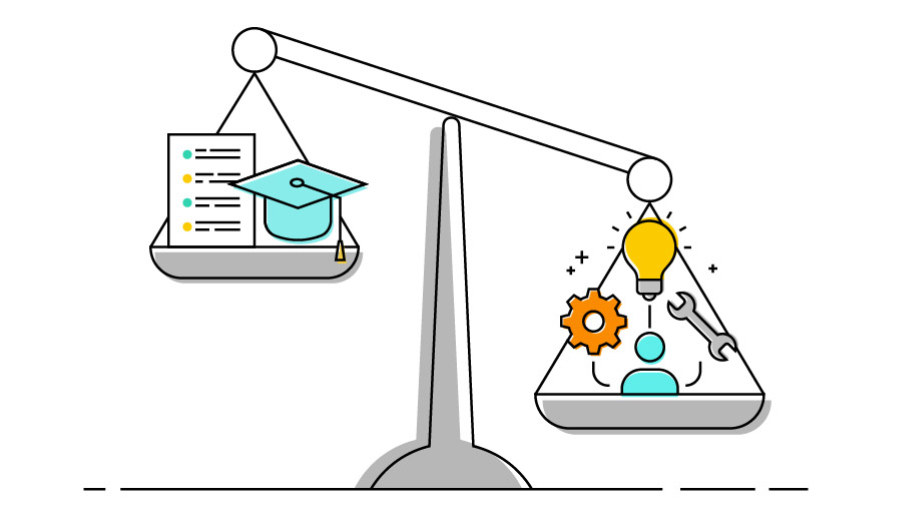
Dominique Silva: For years, degrees and credentials have been treated as the clearest signals of readiness. But as AI takes on more technical tasks, employers need to look more closely at other skills that machines just can't replicate, skills like judgment, collaboration, contextual understanding.
Scott Tew: I mean, in many ways it sounds like the trades have had it right all along, so what does it mean for degree-educated professionals? How should companies think differently about hiring and workforce development in the age of AI?
Dominique Silva: It's a great question. And to help us explore that, we're joined by Joseph Fuller. He's a professor of management practice at Harvard Business School and a leader of the Future of Work project and podcast. I'm Dominique Silva.
Scott Tew: And I'm Scott Tew, and this is Healthy Spaces, conversations at the frontier of sustainable technology.
Joe Fuller: AI is changing the way organizations evaluate candidates for jobs. Our estimate is that about 20% of the jobs in the US economy will actually become open to a broader array of candidates than historically, because AI will take on some tasks that are associated with advanced education, having very specific credentials.
A good example would be a mastery of statistics, which are very important in all sorts of different careers, and AI is very good at statistical analysis. So suddenly, someone applying for a job that historically required a background in statistics will be judged on a different basis than they were in the past. And what becomes more elevated with the application of AI in terms of hiring is a whole category of skills we call social skills. Some people call them foundation skills, power skills. In the historical literature, they're often described as soft skills, which is a term that's kind of out of favor now because it's pretty deceptive, because the skills in that category are not easy to obtain. In fact, they're very high order skills about your capacity to work effectively with others. So your ability to go into an unfamiliar group and be productive, your ability to project how another person you're dealing with appreciates the situation that's confronting the two of you.
Could be a customer, could be a supplier, could be a coworker. How does it feel to be them in these circumstances and be able to process your own reactions through that lens as well as how you're feeling about it? So it tilts the balance a bit, to the things technology is unlikely to be highly facile with in the future.
Dominique Silva: I think that's a really good point you made, Joe, right? About how AI is augmenting our job, not necessarily doing the job for us.
I love that, and I love what you said at the beginning about, well, if AI is making it easier to learn once you're in an organization and do more of the, you know, I think you called it sort of hard tasks, and I'm using quotation marks here with my fingers, it does mean that the kind of skill sets that we can look for in a candidate are broader.
So maybe a job that only one person could do can now be done by 10 different profiles. What, in your opinion, does that mean for the hiring manager and companies that are now going into the market and can no longer rely on the degree or the certificate? How are they going to now tap into a bit more of these social skills, as you called them?
Joe Fuller: This is gonna be a very hard transition for most companies in hiring because historically, the evaluation of someone's social skills is very idiosyncratic to the hiring manager.
Dominique Silva: Okay. So I'm definitely hearing a lot more around skills-based hiring, a lot more attention to behaviors rather than, you know, the number, right, on your last exam. One thing I think, Joe, we can both agree on though is AI can help with the knowledge building. It can't really replace the expertise. So the value of expertise is still very important, and this is one of the things that you wrote about in a recent piece that you wrote together with Matt Sigelman. In this piece that I read, your argument was essentially that AI doesn't make expertise obsolete. It's actually raising the floor on what a capable person can do. I'd love to know from you, what does that actually look like for someone doing a skilled job?
Joe Fuller: Well, AI, to yield productivity improvements, requires the humans that are interacting with it to have what I call contextual intelligence. Why is that? I often tell people, think of the AIs of today as very eager and intelligent interns. So it's very bright, it's very willing, but it really doesn't know what you need or want. It has to be carefully instructed, and therefore, you have to know a lot about the domains that you're asking it to help you with in order to be able to spot when it hallucinates. So it doesn't matter if you're highly knowledgeable about the market for podcasts or the maintenance characteristics of commercial heating and air conditioning systems, or how performance management systems work. As AIs get applied to each of those fields and myriad other ones, a real knowledge of that phenomena, the people that are being served, whether they're customers or managers or employees or citizens, how it all actually kind of works in practice, and also how we in this institution or company do things.
But the AI doesn't know any of those nuances.
Dominique Silva: Right.
Joe Fuller: So it'd have to be prompted and overseen and supervised and quality-checked by someone with sufficient contextual intelligence to extract the value, but not be confused or fooled by error or hallucinations.
Dominique Silva: All right. So there's two types of skills that we've talked about here so far today. One around, I'm gonna simplify and call it the social intelligence, and a new one that you've introduced that I even wrote down because I love it and I'm gonna use it from now on, which is contextual intelligence. I just need to learn how to say the word without stuttering. But I love that. I also love a little bit the metaphor you created there of, you know, think of... And in this case, we're talking about generative AI more specifically, but think about your AI tools as, you know, assistants that have had a very hard night. You really need to tell them what you want, and then you've really gotta critically judge what they're saying. And so this is where the contextual intelligence... See, said it better there. Just 10 more times, it would come out perfect. Makes a lot of sense.
There's one other topic that I wanna pick your brain on if you'll let me, because I know that another subject which you are very passionate about is this concept of degree inflation. So before we head into that, I would love you to explain to our listeners, what do you mean by degree inflation?
Joe Fuller: What's happened over time, Dominique, is that many jobs that historically did not require a post-secondary degree at all. And over time, what we saw is that more and more positions moved from not requiring a candidate to have a college degree to apply for the position to requiring one.
Now, of course, a lot of things have happened. A lot of those people in the job without a college degree have been doing the job for 30 years. What do they have? Contextual intelligence. They know how to do the job. But the requirements of the job over time have changed. A good example would be warehouse manager. It's about the same ratios. A high 60% of the people in the job don't have a college degree. Almost 80% of the job descriptions require one. Well, if you've been in warehouse operations for 20 years, you've lived through multiple technical cycles. But if I'm coming out of university with an engineering degree with a specialty in logistics, and looking for my first job, that same employer saying, "You don't have any experience. I want some other validation that you actually know something about this and will be able to learn quickly. Oh, you have this degree from a good engineering program, and you've studied logistics and logistics propositions. Therefore, I'm gonna use that as a proxy to surmise that you've got sufficient learning background to be able to be productive for this role," even though I may be weighing your application versus somebody with 20 years of experience without a college degree who works for another company.
Dominique Silva: I know another big piece of work that you do and you keep coming back to is this gap between how people are trained and what the job needs. And you've also argued that formal education can't usually keep pace, right, in closing that gap. So keeping in mind all of this change that we've been talking through so far, how can someone build real expertise or contextual intelligence now? And what is the ask of the people who are running these organizations?
Joe Fuller: The easiest way to generate contextual intelligence is actually to have some experience in the role. And you can say, "Well, that's kind of a chicken and egg problem. How do I get the role if I don't have experience?" That's a problem I believe is beginning to become sufficiently widely recognized that we will see over time some changes in employers' behavior. Let's go back to a couple of themes we introduced earlier. I'm an employer, and I need someone with contextual intelligence, and I need someone with higher order social skills. How am I gonna validate those things? The easiest way to validate is not through an interview, not through a simulation, not looking at someone's resume. It's by actually having that person work with you. And I believe we're, over time, gonna see a growth in so-called work-based learning. People often hear that as a proxy for apprenticeship. That's a form of work-based learning. In the United States, we have a number of universities that are based on what they call co-op programs, where you study a subject in school, and then you go to a workplace that's part of the program, and work in a role where the employer is observing you, evaluating you, adding to your knowledge, and also judging whether they want to eventually hire you. They're not obliged to. And most companies are currently configured for most learning to be gained through what we call on-the-job training or on-the-job learning. So beginning to replicate that actually is part of the upstream talent pipeline. Even a worker who gets that work-based learning experience and doesn't receive an offer benefits from it, in a couple of ways. They have some experience which would be valuable to others. They have something material to talk about other than, "Well, I took this course, and I'm eager to get a job," in a job interview. And, importantly, it improves the likelihood that they pursue a career they're actually interested in. The labor market suffers from a very expensive phenomenon called mismatches. It's both I enter down a career path that ultimately I will not enjoy and I'll likely step away from, but I'm pursuing it because I'm ignorant of what the job actually entails.
Similarly, you get mismatches where employers hire someone that isn't well-suited to the work or to their workplace. Work-based learning really helps both those parties avoid expensive mismatches.
Dominique Silva: Yeah, work-based learning. That's another new concept. Well, it's not a new concept, but from what I understand, something which you feel is going to be even more important to reduce this mismatch that you talked about between the expectations of a job and what it actually is. But if I loop it back to how we started this conversation around the need for more social skills or social intelligence, as we call it, contextual intelligence, which are things you cannot measure in a resume, right? There are things you cannot measure in a degree. It's really to learn by doing and actually working together.
Dominique Silva: It seems that work-based learning addresses the real challenge here, overcoming experience barriers and reducing the risk of people entering roles that are not a right fit. And listening to Dr. Joseph, I was reminded that expertise is often built through repetition, observation, and real-world problem-solving, not just about formal credentials.
Scott Tew: Yeah, and that matters. It matters even more in an AI-enabled workplace where contextual intelligence and social skills become even more valuable.
Dominique Silva: I think it's time to listen to someone who's practicing this for real. Do you know who could help us do that, Scott?
Scott Tew: Hmm. I would say it would be valuable to hear from someone in the trades who has progressed through on-the-job learning without a degree.
Dominique Silva: Bingo. So let's turn it over to Marlon Jones. Marlon is the technician experience leader at Trane Technologies Advanced Technology Training Center all the way in Davidson, North Carolina. A 26-year career in HVAC spans apprenticeship, service, building automation, and now he's leading a big team. Let's hear from him.
Marlon Jones: I like to consider it a lucky journey, right? So born and raised in Detroit, Michigan. I started out my career as a residential apprentice, and I was later promoted to a light commercial technician. And then from there, I moved into the commercial side of the business where I gained experience working on large rooftops and chillers.
Then later in my career, I transitioned into the building automation piece where I learned to code, troubleshoot, and work on digital controls. And then from there, I moved into the leadership piece, which is the area service manager for Trane Technologies. Then I was later promoted to area service leader where I led a team of area service managers.
So today, I have the privilege of serving as the technician experience leader for commercial HVAC, where I lead a team that's focused solely on technician experience and delivering a superior technician experience for our technicians.
Dominique Silva: So just out of curiosity, all of this throughout a span of how many years? How many years are we talking about that you've been on this journey?
Marlon Jones: 26 years.
Dominique Silva: 26. I hope, I really hope I am as accomplished as you, Marlon, when I reach 26 years in my career. That's really cool. So you've always sort of stayed within the trade of HVAC. Out of curiosity, what made you pick this trade? Why HVAC?
Marlon Jones: So it all started, I was a maintenance supervisor many years ago, and I was in charge of taking care of a building. Minor maintenance for the most part, but part of that maintenance was the filter changing and the belt changing of a large HVAC commercial system. I ran into an HVAC technician who was assigned to our building, and I kinda tagged along for a day, and he showed me the ropes, kinda showed me what he was into, and I've loved the trade ever since. So he gave me an opportunity to tag along for four or five hours, and twenty-six years later, I'm here standing before you today.
Dominique Silva: That is cool. So it sounds like, Marlon, there's been one thing that you have been driven by from beginning all the way to now, which is curiosity, right? So that one day that you spent basically shadowing an HVAC technician at a building where you were a maintenance supervisor led you down the path which you are on today. So there's a reason why I asked you that question, right, of what made you pick the HVAC trade.
But it's not always about a degree, and that's what I love so much about your story as you're talking through your journey and how you got into the trade. Never once did you say, "Well, I got this degree," or, "I studied this at school and it was a logical choice to make," right? What do you say to that? Do you agree that skilled trades is really not about having a degree? And I'm gonna push it a bit further and ask you, do you think AI is changing that perception too?
Marlon Jones: Absolutely. Great question. So yes, AI is reinforcing something that skilled trades has always known, right? Capability matters most. In HVAC and all trades, success has never been defined by a diploma on the wall. So the way I look at it, it comes down to whether you can solve problems, adapt, keep learning, and deliver for our customers.
And then AI is starting to prove that in a new way. It can make information more accessible and help technicians troubleshoot faster, support training, and shorten the learning curve. So I just look back at when I started, just imagining if I had that powerful tool in my possession or at my fingertips, how much further I could have gotten in my career, and shorten the window or shorten the runway, I guess you could say, to take off.
Dominique Silva: Can I ask you, if you want, Marlon, I can ask you a spinoff question there, right? 'Cause maybe we jumped to the AI a little bit too fast. You know, you've spent 26 years in your career driven by curiosity, learning. You were talking us through how you started with just simple maintenance of air conditioners, now all the way to more complex building automation systems. How do you learn? What's your mechanism to continue learning and keeping up with the new trends and technologies?
Marlon Jones: Well, I look at it as the lifelong learning model. Even before AI, there was always ways to learn, whether it be read various books. Back then it was whatever book you can get your hands on, or hanging out with the experienced senior technician as long as you could to gain knowledge.
So now you fast-forward to where we have these technologies where you have a senior technician in your pocket now essentially, that can help you learn and can guide you through processes and help you troubleshoot as well as do your paperwork, look up parts, which we'll get to later. There's a lot of great benefits to having AI, but I like to look at it as an assistant, a digital assistant in your pocket.
Dominique Silva: So before we jump into talking about AI and how it's changing the way that you work and train service technicians in this trade, I wanna talk still a little bit more about this not needing a degree to be successful in this trade. So in your experience, what are the critical skills which are actually required to become a good HVAC technician?
Marlon Jones: That's a great, great question. So mechanical aptitude, being mechanically inclined, is a major, major piece of it. Great work ethic, or good work ethic at the very least, that's something that you must have. And then having that willing mind, that growth mindset, and that hunger to want to learn, be a lifelong learner.
And then soft skills. And these are things that can be taught, but these are things that you must have. You can be the best technician, but if you don't have the soft skills to interact with our customers, to be able to have the empathy when the customer's upset, then that can hold you back. So those are critical skills that come to mind.
Dominique Silva: Can you think of a scenario or a situation where having those soft skills or that critical thinking made you a better technician?
Marlon Jones: Absolutely. Well, one situation comes to mind, or there are several actually. When you're on call and it's after midnight, my old boss used to say, "You're the only game in town," because everyone's asleep, and you have that hospital or that critical facility that is down. You have a maintenance supervisor who's really upset because of the risk that lies in front of them. And you only have so much time to get that machine up and running. So you have to have the soft skills, you have to have the empathy, show the empathy to make sure the customer understands that you understand the severity of the situation, but then you have to think critically what is wrong with this piece of equipment.
You really can't think about being up against it. You can't really think about how much time you have to get it working. You have to really just think critically and find the best solution. So those are things that can be learned, but it's really what makes a great HVAC technician great, is really just having that empathy. A combination of soft skills, the empathy, the understanding, and then being able to think critically.
Dominique Silva: But I feel that some people out there still really have this perception that to be a service technician, you show up in your dungarees and your toolbox, et cetera. But the profession has changed so much, and as you've already alluded a little bit to us before, AI is actually changing the way you do your work. So how do you think that AI, artificial intelligence, is going to change the work of an HVAC technician on the ground? Give us a couple of examples of what a life could look like.
Marlon Jones: Yeah, so working with AI in the field has the potential to make technicians more prepared, more confident. Like I said, having those resources at your fingertip. I liken it as the next tool in your toolbox or your tool bag. So less time hunting for information, less trial and error troubleshooting, and more time focused on solving customers' problems.
So one good example is how you prep for a service call. Now, going forward in the future, the technician will take that service call, go to their AI tool and pull the building up, the connected building up, and be able to prepare for that call where the AI will tell you things to look for, who's been there, look at past service history, a number of units with issues before you even reach the site. So it's essentially summarizing issues for you, or potential issues, where you can go right directly to the problem, which is gonna minimize downtime for our customers.
Dominique Silva: So we talked about your journey, how you started as an apprentice, and as I alluded at the beginning, you're now leading a team, and more specifically, you're helping to train the next generation of HVAC service technicians. So AI is playing a big role in that. How are you managing this? How are you helping them to navigate what comes next?
Marlon Jones: It's awesome. So we're currently exploring an AI-enabled skills-based system where we'll take in input from your manager, from the technician, and we'll have AI create a custom-made learning path for you. It identifies gaps, it identifies your strengths, your weaknesses, and essentially it's gonna put you in the right place at the right time. What training will you need? Where can you get the training? And it will be a customized training plan for managers to present to the technicians. So AI is really that, I guess you could say, third set of eyes. You have the technician who's gonna give input on a skill, and you're gonna have the manager who's gonna give input, and AI puts it all together and makes it less subjective, right? We wanna get it to the point where it means something. 'Cause we always say garbage in, garbage out, right? So AI's gonna help decipher some things there and help point us in the right direction, and then we're gonna create customized training paths for each technician based off of that.
Dominique Silva: Let's talk about that though, because there's a lot that AI can do, and we've discussed that. AI can indeed bring in a lot of knowledge. But in your view, what are the things that AI tools are not bringing, are not teaching? So what do people still need to bring in with them?
Marlon Jones: So as mentioned, we know AI can help surface information, can speed up troubleshooting, support decision making, but it cannot replace the human side of being a great technician. We alluded to earlier the critical thinking piece is massive. A technician still has to assess the situation, interpret what they're seeing in the field, make sound decisions when the conditions do not match the textbook answer, right? So there's gonna be some times where you've learned a lot of things. You feel like you know what's going on, but you're gonna have to really critically think. AI will not be able to help you through that. So critical thinking is a major piece. And again, the empathy. The empathy when you're working with a customer who's frustrated, dealing with urgent situations, being able to communicate clearly, show understanding, build trust, big part of the job. So that's a major piece as well. So those are the two things that stand out to me, critical thinking and empathy.
There's a lot of things there that AI can't do for us. So very powerful tool, but it can't do those things and never will.
Dominique Silva: All right. So Marlon, the skills that you needed when you started against the ones that the job needs now, in your view, what has changed and what hasn't? What remains the same?
Marlon Jones: So the core job has not changed as much as people may think. When I started, success came down to mechanical aptitude. I think I mentioned work ethic, problem-solving, and the willingness to keep learning, that lifelong learning attitude. Those fundamentals are still the same today. You still have to have all of those things. What has changed though is the environment that a technician's gonna work in. The equipment is more advanced. Customer expectations are higher than ever, and digital tools have been introduced, and they're a part of your everyday work life. So the foundation is the same, but the skills have expanded. So digital literacy is a major factor in how we move forward as service technicians. Those are all core digital skills that didn't exist when I started way, way, way back. So the core of the soft skills and empathy, the critical thinking and work ethic, that stuff transcends generations. Now we're talking about the digital literacy piece, and that's where things have changed tremendously.
Dominique Silva: So at a time when we're all talking about, "Oh my God, is AI gonna take my job?" I think it's just more about it's changing, right? The nature of some jobs and requiring an upskilling, which I think is not unique to the trade, but even in my job, right?
Marlon Jones: So a great AI tool, that's great, but it's only as good as the person who uses it, and also you have to adapt. Digital adoption is a major piece, right? So if we are adopting this in this digital age, our technicians are adopting. So you take a great technician plus a great AI tool, you have a superior technician, and that's what we're looking for. So it's the human element, so it's not an or, it's an and, right? So it's great technician and the AI tool. So that's the biggest... I guess if nothing else makes it to air, I just want our technicians to understand that you take a great technician plus our great AI tool, and you have a superior experience. That's really what we're looking to drive.
Scott Tew: It was really great to hear Marlon's passion for lifelong learning. I mean, 26 years of on-the-job training provides an enormous amount of valuable experience. His story, in my view, is just a reminder that career growth is not always defined by a degree. It's really defined by curiosity and adaptability and the willingness to keep building new skills over time. Other skilled professions can learn a great deal from the trades in that respect.
Dominique Silva: I totally agree. And once again, Marlon has brought us back to what Professor Fuller said at the beginning. Working effectively with AI requires contextual intelligence. I absolutely love that term. The ability to understand nuance, recognize when something is off, and critically evaluate the output.
Scott Tew: I mean, that may be the clearest lesson for the future of work. The people who will be best positioned are not just those who have technical knowledge, but they're the ones who really will keep learning, who will apply judgment, who will communicate well, and those who can adapt as the world and the work changes.
Dominique Silva: And you know what, Scott? Conversations about the future of skilled work are often framed pessimistically.
Scott Tew: Hmm.
Dominique Silva: This conversation suggests something a lot more hopeful, that as the work evolves, human capability matters more. A big thank you to our guests today, Joseph Fuller and Marlon Jones, and thank you for listening.
Scott Tew: This has been Healthy Spaces with me, Scott Tew, and my co-host Dominique Silva. We're back in two weeks with another episode, so be sure to like and subscribe so that you don't miss out.
Digital solutions and AI reshape the future of skilled work
As AI changes the nature of work, distinctly human skills are becoming the real differentiator. For years, degrees and credentials have been the main signal that someone is ready for a job. But as AI begins to handle more technical tasks, from statistical analysis to troubleshooting, employers are placing greater value on the skills machines can’t replicate: judgment, collaboration and the ability to read a situation. That shift is expanding career opportunities for more people while reshaping how companies hire, train and develop talent.
Joseph Fuller, Professor of Management Practice at Harvard Business School and a leader of its Future of Work project, joins Marlon Jones, Technician Experience Leader at the Trane Technologies Advanced Technology Training Center in North Carolina, to discuss how digital solutions and AI are transforming the future of skilled work. AI doesn't make expertise obsolete. It's raising the floor on what a capable person can do. As work evolves, human capability matters more, not less. The people best positioned to succeed are those who continue learning, apply sound judgment, communicate effectively and adapt to change.
Key moments
- 01:10: How AI is widening who gets hired
- 02:00: The social skills machines can’t replicate
- 04:40: Why AI raises the floor on expertise
- 11:00: Work-based learning and avoiding mismatches
- 18:10: Why skilled trades were never about a degree
- 22:50: How AI is changing life in the field
- 24:10: Training the next generation with AI
- 28:40: The hopeful case for the future of work
Featured in this Episode:
Hosts:
-

Marketing Leader EMEA, Trane Technologies
-
Global Head and VP, Sustainability Strategy, Trane Technologies

Guests:
-

Technician Experience Leader, Trane Technologies
-

Professor of Management Practice, Harvard Business School
About Healthy Spaces
Healthy Spaces is a podcast by Trane Technologies where experts and disruptors explore how climate technology and innovation are transforming the spaces where we live, work, learn and play.
This season, hosts Dominique Silva and Scott Tew bring a fresh batch of uplifting stories, featuring inspiring people who are overcoming challenges to drive positive change across multiple industries. We’ll discover how technology and AI can drive business growth, and help the planet breathe a little bit easier.
Listen and subscribe to Healthy Spaces on your favorite podcast platforms.




Topic Tags